Immersive cultural experiences that transform how children understand the world
Traditional education confined to four walls can only take a child so far. When a child stands before the Great Wall of China, watches artisans weave silk in Vietnam, or tastes the spices of Moroccan cuisine, learning transcends textbooks and enters the realm of lived experience.
Cultural education through travel nurtures empathy, critical thinking, and a genuine curiosity about humanity. Children who travel learn that there are many valid ways of living — that the world is vast, diverse, and endlessly fascinating.
Our approach draws on the best of experiential learning theory, combining structured educational frameworks with the spontaneous, joyful discoveries that only travel can provide.
Real contexts, real people, real understanding that sticks for life.
Understanding different perspectives builds compassionate global citizens.
Every experience maps to core academic subjects while exceeding standard outcomes.
of worldschooling children test above grade level in social studies and humanities
faster language acquisition for children in full immersion travel settings
countries represented in our worldschooling family network — every culture, every story
The world's great museums hold centuries of human knowledge — and children who visit them with curiosity and guidance gain an education no textbook can match.
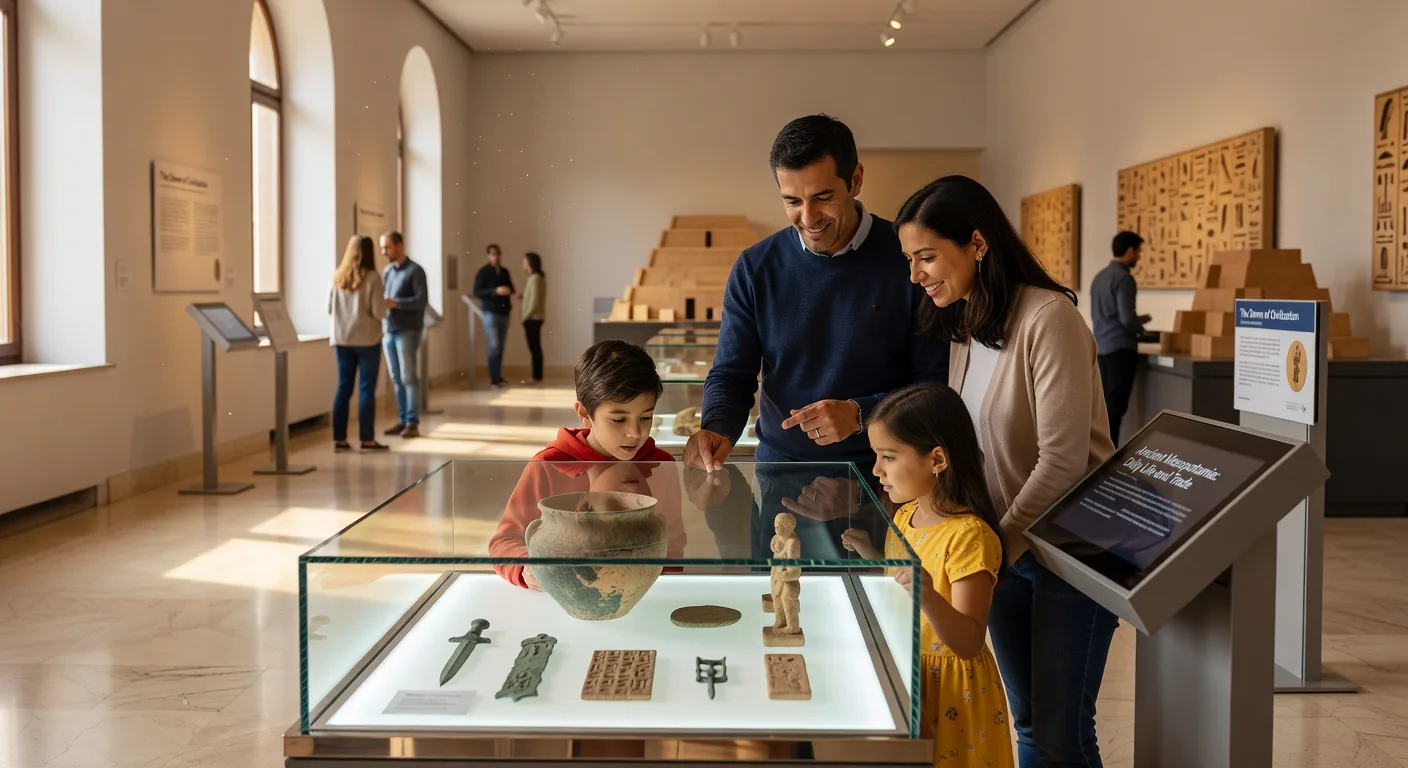
Dinosaurs, evolution, geology, ecology — the story of life on Earth made vivid through fossils, specimens, and immersive dioramas.
STEM learning in action — interactive exhibits, engineering challenges, and demonstrations that spark genuine scientific curiosity.
Art history, cultural expression, the evolution of civilization — a single painting can teach philosophy, politics, and aesthetics all at once.
Period reenactments and restored historical settings bring the past to life — children don't just observe history, they inhabit it.
Hands-on, interactive learning environments designed for children to explore, create, and discover through play-based inquiry.
Children are natural language sponges. Immersed in a living language, with real people to talk to and real reasons to communicate, acquisition accelerates in ways that classroom study simply cannot replicate.
Enroll your child in a local school for one to four weeks. The social motivation to communicate creates rapid vocabulary acquisition and genuine friendships that reinforce learning far beyond any lesson plan.
Living with a host family removes the safety net of your own language. Mealtimes, errands, and daily routines become language lessons. Children adapt with remarkable speed when their needs depend on communication.
Partner with a local family for mutual language exchange. Your children teach English while learning the local language — a structured, social approach that builds confidence and genuine cross-cultural friendships.
Playgrounds, nursery rhymes, picture books, and singing games. Total immersion through play with local children works beautifully at this age.
Short school stints, local comics and children's books, structured vocabulary games, and cooking/craft activities with language labels.
Language apps, social media in the target language, local teen friendships, music, and film — social motivation is powerful at this age.
Structured language courses, formal homestays, work-shadowing with local mentors, and independent language learning goals and journaling.
Mexico, Peru, Spain, Argentina
France, Morocco, Vietnam, Senegal
Tokyo, Kyoto, Osaka
Taiwan, Chengdu, Singapore
Florence, Sicily, Bologna
Festivals are a culture's heartbeat — moments when history, belief, art, and community converge in a single celebration. Click any festival to explore its educational dimensions.
Every dish tells a story of trade routes, climate, colonization, and culture. Teaching children to cook and eat around the world is one of the most delicious forms of education.
Map the ancient spice routes from Indonesia to Europe. Each spice in the market tells the story of maritime exploration, empire, and global trade networks that shaped the modern world.
Create a world map pinning the origin of each ingredient in a meal. A simple Italian tomato sauce traces to the Americas — revealing the Columbian Exchange in every bite.
Visit local markets to understand food systems, seasonal eating, and agricultural economy. Practice math with currency, budgeting, and negotiation in the local language.
Cook traditional recipes with local grandmothers. These oral traditions carry cultural memory — flavors that have remained unchanged for centuries carry entire civilizations within them.
Traditional washoku cooking — dashi making, vegetable cutting, miso soup — in a historic machiya townhouse
Tagine and couscous preparation in a riad kitchen, with a morning trip to the souk for fresh spices
Rajasthani thali cooking class — learn to balance the six tastes of Ayurvedic cuisine with a local family
Farm-to-table Thai cooking — visit the organic garden, learn about lemongrass, galangal, and kaffir lime
Fresh pasta and ragù in the food capital of Italy — understanding the difference between regional Italian cuisines
Ceviche and causa preparation with a Lima chef — exploring the Asian, African, and indigenous influences in Peruvian cuisine
Handcraft traditions encode centuries of cultural knowledge — geometry, natural science, history, and philosophy expressed through skilled hands. Participating in these traditions is learning at its most embodied.
Origami teaches geometry, patience, and the Japanese aesthetic of simplicity and precision. Washi paper-making connects children to forest ecology and traditional craft economics.
Oaxacan black clay pottery and Puebla's Talavera tiles trace histories of indigenous craft, Spanish colonial influence, and the way artistic traditions survive and adapt across centuries.
The geometric precision of Moroccan tile-work is applied mathematics — Islamic geometric art encodes sophisticated principles of symmetry, tessellation, and number theory in breathtaking beauty.
Rajasthani block printing reveals connections between textile history, trade, and cultural identity. Children learn about natural dyes, pattern repetition, and the economics of artisan communities.
Traditional Quechua weaving uses a complex coding system — patterns record history, identity, and community. Learning to weave even basic patterns opens an entirely different concept of "text."
From Ukrainian pysanky eggs to Polish wycinanki paper-cutting, folk art traditions preserve pre-Christian symbolism, seasonal cycles, and community identity across generations of upheaval.
Every Balinese carving connects to Hindu mythology and cosmology. Working alongside a master carver, children learn about spiritual symbolism, forest materials, and generational craft knowledge.
Masks in West African traditions are not decorative — they are ceremonial technology that connects the living to ancestors and spirit worlds. Studying them opens rich conversations about spirituality, community, and art's purpose.
Every cultural experience is a multi-disciplinary lesson. Here is how to intentionally connect what children see and do to the subjects they are studying.
Daily reflective writing, sketches, and observations. Teach children to record what they see, feel, wonder, and question — not just what they did.
Assign children a theme — "Doors of Morocco," "Street Food of Bangkok" — and teach them to tell visual stories with intent and composition.
Using a phone or tablet, children can interview locals, narrate their own experiences, and edit a short documentary about a culture, place, or person they encountered.
Hand-drawn illustrated maps of countries visited, featuring key learnings, favorite foods, vocabulary words, and memorable encounters — a living geography portfolio.
Choose one topic per destination — Aztec astronomy in Mexico, silk production in Vietnam — and compile a proper research report with sources, bibliography, and original analysis.
Record short podcast episodes about each destination — interview family members about what they learned, discuss controversies, compare experiences across cultures.
A comprehensive PDF with curriculum frameworks, festival calendars, museum checklists, and printable worksheets for worldschooling families.
Trusted by 12,000+ worldschooling families. No spam, ever.