Complete Guide
Homeschooling on the Road
Practical systems, curriculum resources, and community support for families who learn wherever they roam.
Complete Guide
Practical systems, curriculum resources, and community support for families who learn wherever they roam.
Understanding the Landscape
These terms are often used interchangeably, but they represent meaningfully different approaches. Understanding the distinctions helps families choose the path that fits them.
The broadest category. Homeschooling means educating your children outside of a traditional school institution, typically from a fixed home base. Parents take on full or primary responsibility for their child's education, choosing curriculum, setting schedules, and managing assessments. The family remains geographically stable — what changes is the institution responsible for education. Homeschooling has existed for centuries and is now practiced by millions of families in every major country.
Roadschooling is homeschooling conducted while the family travels — often by RV, van, or slow train across a country or region. The term "roadschooling" is most commonly used by American families traveling within the US, though it's applied globally. The travel itself forms a significant part of the curriculum: roadschooling families might stop at national parks, historical sites, science museums, and working farms, using each destination as a classroom. The pace is often leisurely, with weeks spent in each location.
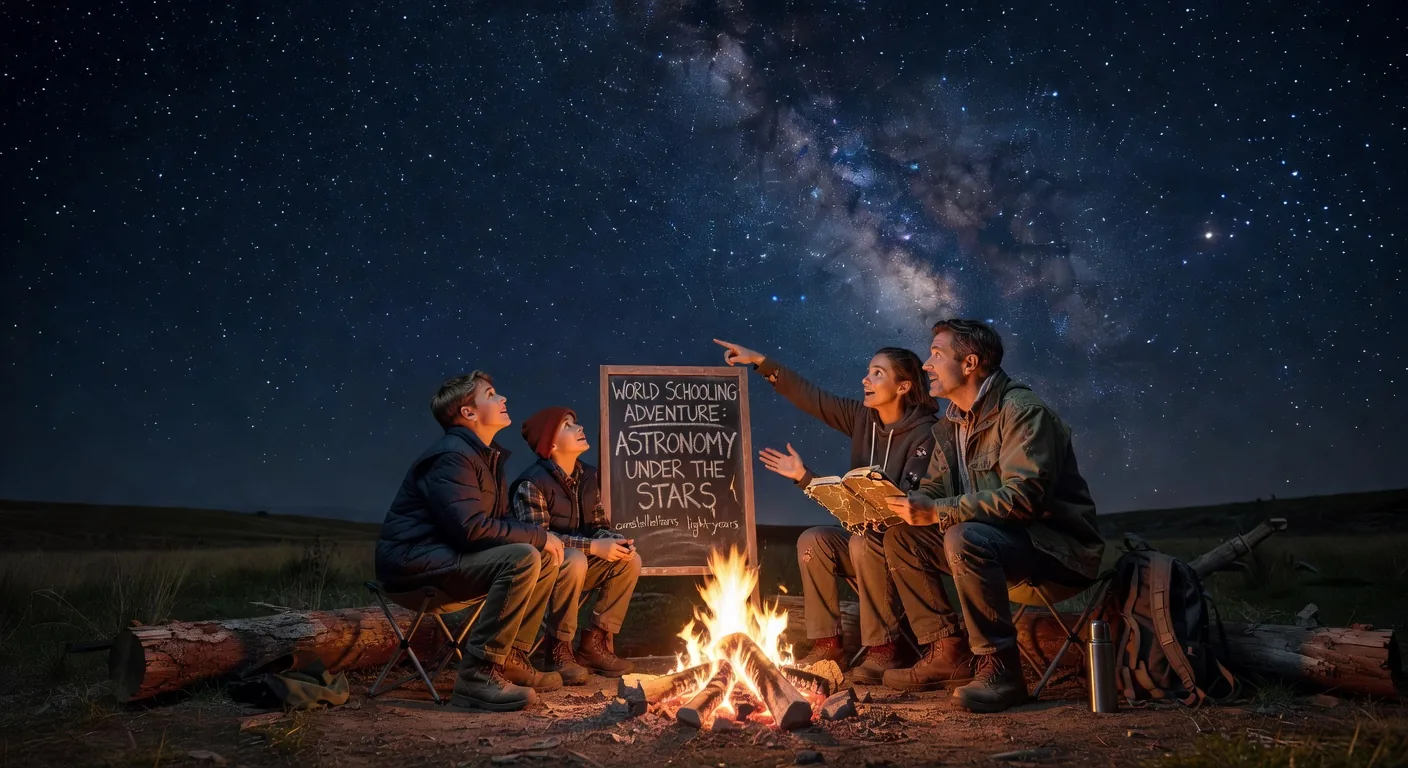
Worldschooling takes roadschooling global. Families travel internationally, immersing children in radically different cultures, languages, histories, and environments. The world — in all its linguistic, cultural, ecological, and historical richness — becomes the curriculum. Worldschooling differs from extended family travel in its intentionality: worldschooling families design educational goals, document learning, maintain curriculum continuity, and use each destination's unique offerings as teaching tools. It's travel as a pedagogical philosophy.
Know Before You Go
Homeschooling laws vary dramatically by country. Always consult a legal professional familiar with your home country's education laws before withdrawing children from school.
| Country | Legal Status | Registration Required | Oversight Level | Notes for Travelers |
|---|---|---|---|---|
| USA | Legal (all states) | Varies by state | Low to Moderate | State-specific. Texas, Oklahoma: minimal oversight. NY, PA: high oversight. Notify home state before traveling. |
| United Kingdom | Legal | Not required | Low | Parents have the right to home educate with no formal registration required. Council may make informal contact. |
| Australia | Legal | Required | Moderate | Register with state/territory authority before departure. Program approval usually required but straightforward. |
| Canada | Legal (all provinces) | Varies by province | Low to Moderate | Alberta and British Columbia are the most worldschooling-friendly provinces. Ontario requires registration. |
| New Zealand | Legal | Required | Low | Apply to Ministry of Education for an exemption certificate. Process is well-established and family-friendly. |
| Germany | Illegal | N/A | Compulsory school attendance | Homeschooling is illegal under German law. Families often emigrate or use international schools. Legal advice essential. |
| France | Legal (restricted) | Required annually | High | Recent legislation (2021) significantly restricted homeschooling. Families must demonstrate exceptional circumstances. |
| Spain | Legal (gray area) | Not recognized | Varies by region | No formal legal framework for homeschooling. Many families operate informally. Tolerance varies by autonomous community. |
| Japan | Legal (de facto) | Not required | Low | No specific homeschooling law, but families can legally choose not to send children to school. Common for expat families. |
Most home countries require you to register or notify authorities before leaving. Check with your local education authority 6–8 weeks before departure. Keep copies of all correspondence.
Build a documented portfolio from day one: dated learning logs, curriculum materials, photographs of projects, and written assessments. This is your educational evidence if authorities ever inquire.
If you plan to re-enroll in traditional school, research the re-entry process before you leave. Most schools accept portfolios and standardized test results as evidence of educational progress.
Educational Approaches
Structured homeschooling uses professionally designed, grade-level curriculum packages that provide day-by-day lesson plans, assessments, and teacher guides. For families who want the security of knowing their children are hitting educational benchmarks, a boxed curriculum provides enormous peace of mind. These curricula are designed to travel — most materials are digital or compact enough to pack.
The main challenge is rigidity: a structured curriculum doesn't pause for the three-week rabbit hole your child falls into when they discover Roman engineering in person. The best approach is to use the curriculum as a framework while allowing flexibility when travel provides superior learning opportunities.
K–8 accredited curriculum with teacher support. Excellent for families re-entering traditional school. Available digitally.
Arts-integrated, nature-based curriculum. K–12. Beautiful physical materials. Particularly beloved by worldschooling families for its flexible philosophy.
Full online school with live teachers and accreditation. Works best with stable internet. Ideal for families in one location for 2+ months.
Flexible accredited curriculum. Allows significant customization. Good support system for parents new to homeschooling.
Unschooling, popularized by educator John Holt in the 1970s, operates from a radical premise: children are natural learners who, when freed from compulsion and given rich environments, will pursue the knowledge and skills they need. There is no set curriculum, no fixed schedule, and no tests. Instead, children lead. Parents facilitate, provide resources, ask questions, and follow their children's interests wherever they lead.
For worldschoolers, unschooling is a natural fit. Travel provides a naturally rich environment: new languages, unfamiliar foods, ancient ruins, local craftspeople, market mathematics, and cultural ceremonies. An unschooling worldschooler who spends three months in Japan may emerge with conversational Japanese, a deep understanding of Shinto architecture, advanced origami skills, and a personal study of Japanese manga illustration — none of it assigned, all of it genuine.
The criticism of unschooling — that gaps develop — is real and worth taking seriously. Most unschooling families address this by ensuring their environments are genuinely rich, by engaging actively with their children's interests, and by periodically checking in against educational benchmarks.
Charlotte Mason was a 19th-century British educator who believed children deserve a feast of ideas, not a diet of dry facts. Her method centers on "living books" — richly written, narrative-driven texts that bring subjects to life — rather than textbooks. It also emphasizes daily nature study, narration (having the child tell back what they've learned rather than take tests), short focused lessons, and exposure to great art and music.
Charlotte Mason's method is exquisitely suited to travel. A family in Tuscany can study Renaissance art in the original, sketch botanical illustrations of local wildflowers, read a living biography of da Vinci, and narrate what they observed at the Uffizi Gallery. The method's emphasis on atmosphere and beauty aligns naturally with the worldschooling ethos.
Free Charlotte Mason curriculum. Beautifully curated book lists by year. Strong community forums for support and questions.
Comprehensive paid resources including scheduling tools, book studies, and nature journal guides. Excellent for beginners.
Classical education is structured around the Trivium — Grammar, Logic, and Rhetoric — the three stages of intellectual development corresponding to childhood, early adolescence, and later adolescence. In the Grammar stage (roughly ages 6–10), children absorb facts, learn languages, and build a storehouse of knowledge. In the Logic stage (10–14), they learn to reason, argue, and analyze. In the Rhetoric stage (14+), they learn to communicate persuasively and originally.
Classical education places enormous value on primary sources, Latin (often), mathematics as pure reasoning, and the Western canon of great literature and philosophy. For worldschoolers, the classical framework provides intellectual rigor and historical depth. A family studying Rome classically isn't just visiting the Colosseum — they're reading Caesar's Gallic Wars in the original Latin, debating Roman governance using Cicero's texts, and writing original orations on citizenship.
The definitive guide to classical homeschooling by Susan Wise Bauer. The curriculum families use worldwide. Rigorous and comprehensive.
Community-based classical curriculum with co-op groups worldwide — including international chapters. Good for worldschoolers wanting community structure.
The most popular approach among experienced worldschoolers. Eclectic homeschoolers take what works from each method and discard what doesn't. A family might use Teaching Textbooks for math (structured, self-directed, sequential), Ambleside Online reading lists for literature (Charlotte Mason), Duolingo for language (gamified self-directed), Khan Academy for science (structured, self-paced), and pure unschooling for everything else.
The eclectic approach requires the most parent judgment — you have to know your child well enough to know which subjects need structure and which benefit from freedom. But it also allows the most personalization, and for worldschooling families, it's the most flexible. When you arrive in Japan, you can drop the structured history curriculum entirely for three months and replace it with living Japanese history through shrines, museums, tea ceremonies, and conversations with local families.
The key to successful eclectic homeschooling is tracking coverage areas periodically and being honest about gaps. The world provides extraordinary breadth; the eclectic parent's job is to ensure it also provides depth.
Our own framework, developed over 12 years of working with thousands of families. We call it the Integrated Travel Curriculum (ITC). It's built on three pillars: a Core Thread (continuous, non-negotiable daily work in math and reading/writing), a Destination Study (deep immersion in the culture, history, ecology, and language of your current location), and an Inquiry Project (a child-led deep dive into whatever has captured their imagination).
The Core Thread takes 60–90 minutes daily and keeps foundational skills sharp. The Destination Study takes 60–90 minutes and is guided by our country-specific study guides, which include vocabulary, history units, cultural activities, local author reading lists, and project ideas. The Inquiry Project is entirely child-directed and documented in a portfolio.
Math (Teaching Textbooks or Beast Academy) + Writing (Brave Writer) + Reading (assigned and free choice). Non-negotiable foundation.
Our custom country guides include 6-week study units with history, geography, language, culture, ecology, and local literature. Available for 50+ countries.
Child-led 4–8 week deep dives documented in physical or digital portfolios. Past examples: Roman aqueduct engineering, Balinese textile dyeing, Amazon ethnobotany.
Weekly reflection practice. Monthly portfolio reviews. Annual transcript compilation. These materials are accepted by schools and universities globally.
Day in the Life
Ages 4–8 — 3 to 4 hours structured
Ages 9–12 — 4 to 5 hours structured
Ages 13+ — Self-directed + online courses
Digital Tools
Comprehensive, self-paced curriculum covering math, science, history, and more. Works offline in many areas. Available in 40+ languages. Our top recommendation for math continuity.
Live online classes taught by independent teachers. Thousands of options from creative writing to astrophysics to Minecraft engineering. Perfect for social connection while traveling.
Gamified language learning for 40+ languages. Works offline. Ideal for daily language practice. Pair with local language tutors for conversation practice to dramatically accelerate acquisition.
Self-grading math curriculum from pre-algebra through calculus. Audio and visual explanations for every problem. The gold standard for worldschooling families who want reliable math progression.
Narrative world history in four volumes, covering ancient times through the modern age. Written in story format rather than textbook format. Pairs beautifully with travel to historical sites.
Writing curriculum built around reading great literature and writing about it authentically. Reduces the battles around writing. Particularly excellent for ages 8–14. Flexible, gentle approach.
Agricultural Education
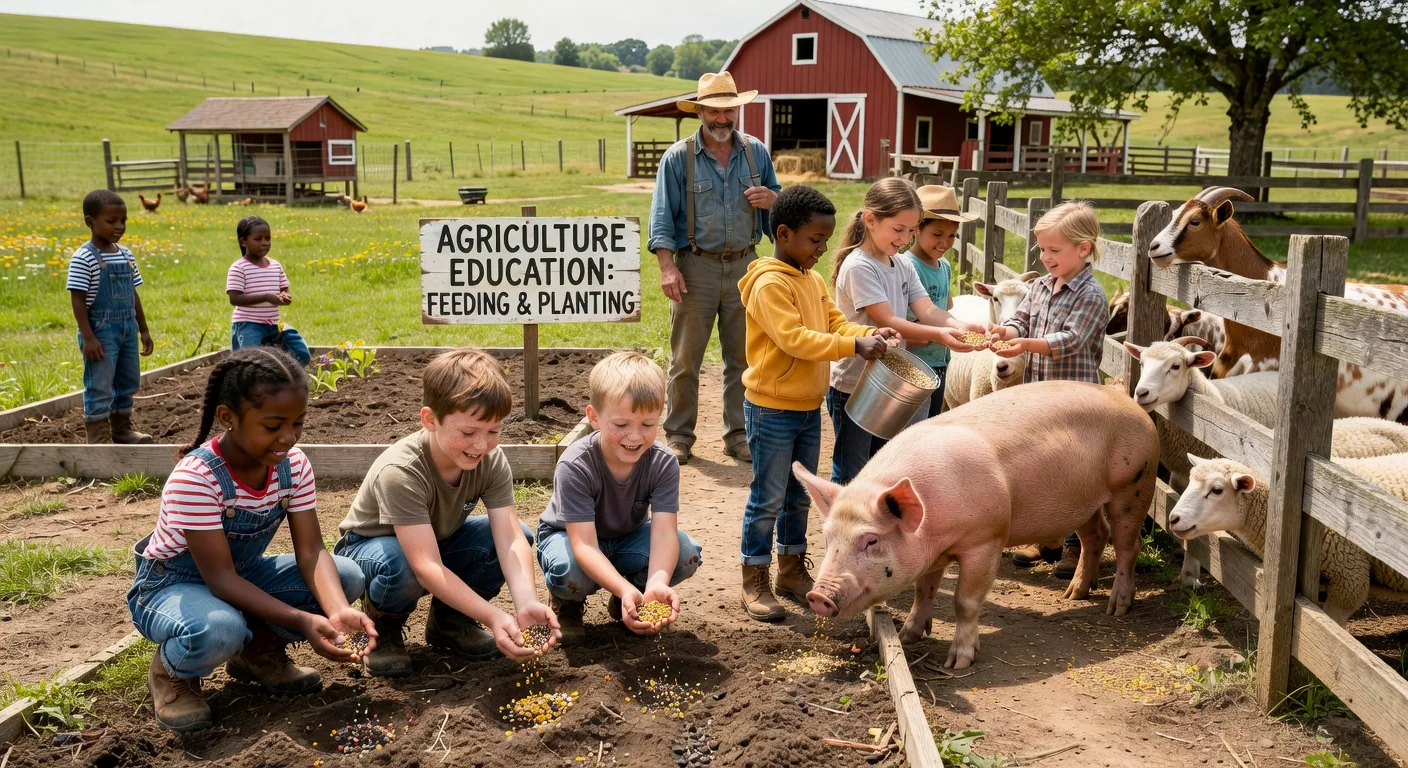
Farm stays are among the most powerful educational experiences available to worldschooling families. A working farm teaches biology, ecology, economics, chemistry, meteorology, zoology, and the deep human truth that all life depends on the Earth — lessons that no classroom can replicate.
We partner with a growing network of family farms, permaculture centers, and agricultural education projects worldwide. From olive harvesting in Crete to rice planting in Bali, from cheese-making in rural France to alpaca farming in Peru, each farm stay is a semester's worth of education condensed into weeks.
The WWOOF (World Wide Opportunities on Organic Farms) network lists thousands of farms in over 100 countries that welcome families. HelpX and WorkAway also list agricultural positions. Many families organize their entire annual itinerary around three or four extended farm stays bookended by urban cultural immersion.
Documentation
A well-maintained portfolio is your insurance policy, your celebration of growth, and your re-entry ticket. Build it from day one.
Daily or weekly written journals provide the richest documentation of learning. Encourage children to write observations, questions, and reflections — not just "what we did today" but what they noticed, what surprised them, and what they want to know more about.
Photographs with captions constitute powerful educational documentation. Encourage children to take their own photographs with intent — not just snapshots, but visual notes. "I photographed this because..." is a valuable reflective practice that develops observational and analytical skills.
Short weekly video reflections — children talking to a camera about what they've been learning — are increasingly valued by university admissions offices as evidence of self-directed learning. They also become treasured family archives.
Homeschool Tracker (iOS/Android) allows parents to log subjects, hours, and activities against educational standards. Seesaw enables children to document their work digitally with photos, audio, and written reflections. Both export as PDF transcripts.
For re-entry into traditional school or university applications, transcripts listing subjects studied, hours completed, and grades (if applicable) are typically required. We provide a free transcript template aligned to US, UK, Australian, and IB standards.
Deep project work — the 6–8 week inquiry projects that form the heart of the Dynamic Focus Lab method — should be documented comprehensively: initial question, research process, fieldwork, drafts, final product, and reflection. These form the centerpiece of any educational portfolio.
Academic Pathways
Worldschooled students have successfully enrolled in universities around the world, including Oxbridge, Ivy League institutions, and top universities in Australia, Japan, and Europe. The path requires planning, but it is well-traveled.
Both tests are offered at international testing centers in over 100 countries. Register 6–8 weeks in advance. Most worldschooled students perform above average given their depth of real-world learning.
The IB Primary Years Programme (PYP), Middle Years Programme (MYP), and Diploma Programme (DP) are internationally recognized and philosophically aligned with worldschooling values. Many IB schools worldwide accept homeschooled exam candidates.
Cambridge Assessment International Education offers IGCSEs and A-Levels to private candidates worldwide. These are widely accepted by UK universities and increasingly recognized globally.
Many universities — particularly liberal arts colleges in the US and forward-thinking institutions in Europe — actively welcome homeschooled applicants with strong portfolios. The key is a compelling narrative of learning depth and self-direction.
Finding Your Tribe
The worldschooling community is one of the most generous and supportive in the education world. Once you find your tribe, you'll never feel alone on the road.
Honest Conversations
Every worldschooling family hits bumps. Here are the most common ones — and how experienced families navigate them.
Math is the subject worldschooling families worry about most — and with good reason. Unlike history or science, where gaps can be filled contextually, math is genuinely sequential: you cannot do algebra without arithmetic. Our recommendation: never skip math. Choose one program (Teaching Textbooks, Khan Academy, or Beast Academy) and do at least one lesson every day except on dedicated field experience days. Treat math like brushing teeth — non-negotiable, daily, brief, and non-dramatic. Families who approach it this way rarely fall behind.
The socialization question is the one non-worldschoolers ask most often, and the one worldschooling families worry about most in their first year. Two strategies make the biggest difference: first, stay longer in each place (6+ weeks gives children time to build real friendships, not just playdate acquaintances); second, join activities rather than just visiting attractions. A child who attends swimming lessons, a martial arts class, or a local art workshop will make friends infinitely faster than one who moves from tourist site to tourist site. The worldschooling community itself is also a rich social network — families in the same city often meet up regularly.
Screen time is genuinely harder to manage on the road, where children may have long travel days with limited stimulation and where parents are also working remotely. A few principles that work:
Teaching your own children while managing travel logistics, working remotely, navigating foreign systems, and maintaining a relationship is extraordinarily demanding. Parent burnout is real, common, and under-discussed. Protect yourself: build in days where the children have structured independent work and you have time alone. Stay in one place long enough to establish routine and community. Prioritize activities where the environment teaches rather than you — a great museum, a working farm, a language immersion class. Connect with other worldschooling parents who understand. And be willing to pause the journey if you need to. A year of excellent stationary homeschooling is infinitely better than continuing to travel while burned out.
Free Resource
Everything you need to get started: legal checklist, curriculum comparison guide, daily schedule templates, packing list, and our country research worksheet. Free.
We'll also send you our monthly worldschooling newsletter. Unsubscribe anytime.